Surprise, You Are Fired!
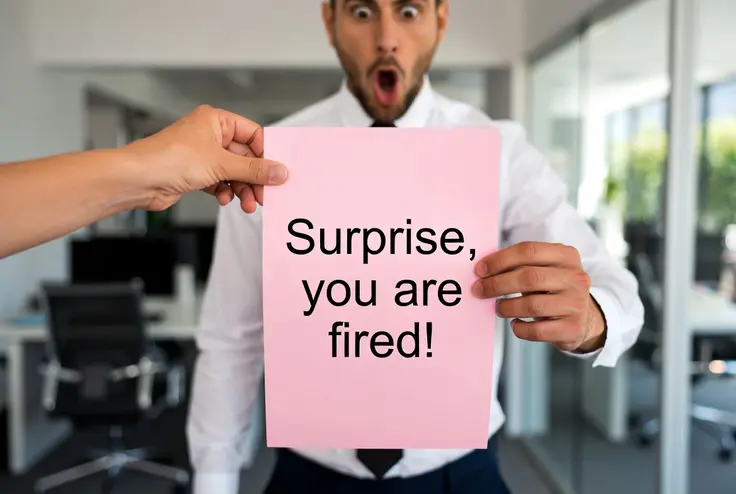
This post has been motivated by recent, let’s call them incidents, where people I know or I have heard stories about, had been fired to the surprise of themselves and their peers. This is a big red flag mostly to the establishments where such things happen. Let’s call this phenomenon SURF.
If a person is summoned to a meeting, told that he/she is being sacked, and that person is surprised, then Houston, we have problem. Such an event would indicate a systemic problem on team or even company level where issues with performance are not communicated properly.
There must be multiple steps in between identifying a performance problem and that last meeting where the decision to part ways is communicated. Identifying problems is a key responsiblity of senior staff (like a team leader) and if that responsibility is not observed, it is the senior staff that is underperforming. We cannot be expecting that people will always manage to perform on par throughout their careers without any guidance. We cannot be expecting that people magically know that they are not performing well.
Let’s first examine why someone might have ended up in such situation and then explore potential remedies. Most commonly, the above-mentioned problem appears because people are reluctant to have hard conversations (which is a topic on itself and will be explored in a follow-up article) but let’s see the full list.
Red Flags in Leadership
Fundamental Communication Failure
- Conflict-avoidance or simply not having real conversations with people
- Unwillingness to deliver uncomfortable truths
- Giving vague, overly positive feedback that masks real issues
Lack of Situational Awareness
- Not paying attention to what team members are actually doing day to day
- Inability to distinguish between someone who is struggling and someone who is performing well
- Managing from a distance — administratively rather than hands-on
- No pulse on team dynamics or individual trajectories
Poor Judgment and Prioritization
- Not recognizing a problem early enough
- Ignoring a recognized problem
- Reactive rather than proactive
- Confusing being “nice” with being a good manager
Accountability Blindspot
- Allowing a situation to develop where someone else (HR, upper management) has to do the hard work they should have done
Malice
- Public or private disagreements with the team lead
- Person perceived as threat due to competence
- Deliberately vague or withheld feedback
- Performance standards applied inconsistently
- Singling out people because they are not liked
Any of those red flags can mean a problem. Many times, multiple red flags are active. Let’s now take a look at a checklist for management and team leads which can prevent surprise terminations.
Checklist for preventing SURF
Ongoing Communication
- Hold regular 1-on-1s with every team member
- Make performance expectations explicit and documented
- Give real-time feedback — don’t save it for formal reviews
- Create a psychologically safe environment where issues can surface early
Early Problem Identification
- Define clear, measurable performance benchmarks for each role
- Monitor for early warning signs (missed deadlines, quality dips, disengagement)
- Address small issues immediately, before they compound
- Distinguish between a skills gap, a motivation problem, or a personal circumstance
Formal Performance Process
- Issue a verbal warning with specific, documented examples before anything formal
- Follow up with a written warning if the issue persists, again with concrete examples
- Put a Performance Improvement Plan (PIP) in place with clear goals, timeline, and support offered
- Schedule check-ins specifically to track PIP progress
- Ensure HR are in the loop
The “No Surprise” Rule
- Ask yourself: “Would this person be shocked if I let them go today?” — if yes, you are not done yet
- Make sure the employee can articulate, in their own words, what the problem is and what is expected of them
- Document every conversation related to performance — dates, what was said, what was agreed
Manager Self-Check
- Am I giving feedback because it’s uncomfortable, or am I avoiding it?
- Have I given this person the tools, training, and context they need to succeed?
- Is the underperformance actually a management or process failure in disguise?
- Would my own manager consider me to be underperforming if they saw how I handled this?
The checklist is pretty exhaustive and can help anyone to spot omissions that can lead to SURF.
In closing I want to reiterate that if someone had been let go and is surprised is usually a signal that there is a problem on a team or company level and this problem needs to be addressed immediately.
Surprise terminations do not happen in healthy teams. If they are happening in yours, the checklist above is a starting point — but the real work is building a culture where hard conversations are normal, not exceptional.